From sheltered to sustainable – A practical framework for ADE transformation
by Dominic Leaver and Les Hems

Right thinking
There is an urgent need for Australian Disability Enterprises (ADEs) to transition from traditional, segregated models towards sustainable, inclusive employment pathways for people with disability. With government policy and sector trends increasingly favouring open employment and market wages by 2034, ADEs face significant challenges: declining supported employment numbers, ADE closures and limited success in transitioning employees to mainstream work.
In this article we propose a practical transformation framework, emphasising three core opportunities: commercial sustainability, workforce integration and wage equality.
The framework supports ADEs to deliver commercially viable offerings, uphold human rights and create genuine pathways to inclusion, helping build a resilient and equitable future
for disability employment in Australia.
A long-term vision for disability employment is emerging, without a clear roadmap for transformation
For people with disability, employment offers an opportunity to earn, spend and save, be productive, learn new skills, and build work-placed social networks. It is a fundamental human right for people with disability ‘to work on an equal basis with others’ (United Nations, 2006).
A longer-term vision for disability employment is emerging in government policy and the operating environment; however, how to get there remains unclear.
The 2019 Disability Royal Commission recommendations for employment focused on the transition away from segregated ADEs and toward a future of disability employment focused on work integration social enterprises and open employment with market wages by 2034.
While the Commonwealth has yet to commit to these recommendations and uncertainty abounds, policy directions and trajectories point to a future in which:
- people with disability have a range of genuine and established pathways into open employment on full award/minimum wages that include periods of time working in a supported environment on productivity-adjusted wages
- outdated, segregated ADEs without a commercial offering or genuine support for people to explore employment pathways will no longer exist
- ADEs that have transformed thrive by delivering a commercially sustainable offering and delivering an employment model that upholds human rights and offers genuine pathways to inclusion
- providers receive outcome-based payments for employment, training or goal-related outcomes achieved, rather than the current activity-based payments today.
The challenge: complex, urgent and uneven
Given the near-term policy uncertainty, many ADEs are struggling.
We have seen:
- More than 20% decline in overall supported employment of people with disability from an estimated 20,000 people employed in 2018 (People with Disability Australia, 2018) to ~15,300 people in 2024 (National Disability Insurance Agency, 2024).
- Closure, partial closure or near collapse of many ADEs (for example, Afford 2025 (Australian Foundation for Disability, 2025); Bedford Group 2025 (ABC News, 2025); and Activ Foundation 2022 (National Disability Services, 2022).
- Insufficient or reducing demand for ADE commercial services and balance sheet erosion to keep the doors open (Australian Foundation for Disability, 2025).
- Limited success in supporting ADE employees to transition into open employment settings (National Disability Insurance Agency, 2024).
At the same time, people with disability need expanded (not narrowing) opportunities, continuity of work, fair pay and real career pathways. The stakes are high and the path forward isn’t one-size-fits-all.
Why transformation must be pragmatic
Our work in the sector has illustrated that transformation starts with a commitment …
Before initiating any transformation, organisations must be committed to better employment outcomes for people with disability through contemporary and compelling employment pathways and opportunities.
… but transformation doesn’t happen overnight.
ADEs need practical, sequenced moves that reflect where their business is today.
The question is: where do you start?
Disability Employment Transformation Framework
At Right Lane Consulting, we have developed a structured approach to help ADEs navigate this transition. It starts with three core opportunities:
- A sustainable commercial offering and business model.
- A more integrated workforce with diverse employee opportunities for exploring new pathways and skills.
- Wage and employment conditions equality.
From our experience working with diverse providers and employers, each organisation’s starting point is unique; they will be driven by their own specific aspirations and imperatives.
Depending on your organisation’s starting point, there are a variety of high-level strategic levers and moves that you can explore to address the organisation’s aspirations and change imperatives.
We see this framework as the menu of transformation options that leadership teams must consider holistically, then determine which combination and sequence of moves best enable your intended strategic objectives.

Disability Employment Transformation Framework
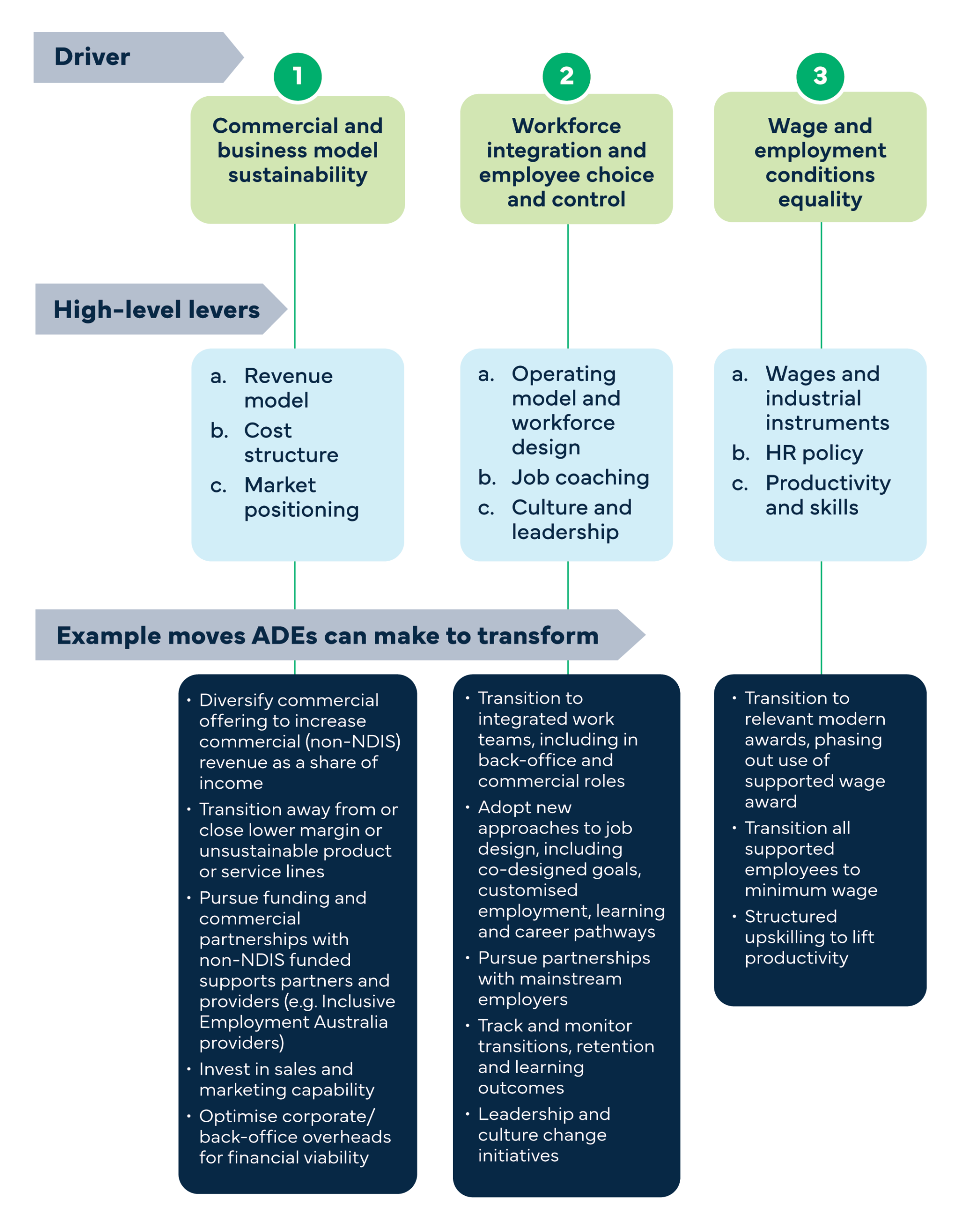
This framework is shown at a high level to illustrate the core concepts. If you’re interested in exploring the detailed version and its application, we’d be happy to have a conversation.

Practical next steps for ADE leaders
- Define your starting point: Begin with a clear-eyed assessment of your current operating context, strengths and challenges. Identify which transformation drivers, (commercial sustainability, workforce integration, or wage equality) require immediate attention. Don’t try to change everything at once; prioritise based on urgency, impact, and feasibility.
Example strategic questions to consider at this stage:
What is our most urgent transformation priority—commercial sustainability, workforce integration, or wage equality?
What are the biggest risks or barriers in our current operating model?
- Define the future state: Articulate a compelling vision for your organisation’s future, grounded in an evidence base and, if needed, a robust business case. This should include what success looks like for each transformation driver, and how your ADE will deliver sustainable, inclusive employment pathways.
Example strategic questions to consider at this stage:
What does ‘success’ look like for our ADE in 3, 5, and 10 years?How will our commercial offering evolve to meet market needs and policy changes?What workforce composition and culture do we aspire to?
What wage and employment conditions will we offer?
- Build a 12–24 month roadmap: Develop a sequenced action plan that sets out key initiatives, milestones and responsibilities. Focus on practical moves that will ‘move the needle’ for your priority drivers, ensuring each step is achievable and measurable.
Example strategic questions to consider at this stage:
Which 2–3 initiatives will have the greatest impact on our transformation goals in the next 12–24 months?What partnerships (mainstream employers, funders, sector bodies) can accelerate our progress?
How will we manage change and support our workforce through the transition?
- Track what matters: Establish clear metrics and reporting processes to monitor progress against your transformation drivers. Regularly review outcomes such as wage uplift, revenue mix, and transitions to open employment, and use these insights to refine your strategy.
Example strategic questions to consider at this stage:
What are the most meaningful metrics to monitor our progress (e.g. wage uplift, revenue mix, transitions to open employment)?
How will we use data and feedback to refine our strategy over time?
The future of disability employment in Australia depends on bold, practical moves today.
If you’re an ADE leader or sector stakeholder, let’s talk about how this framework can help build a sustainable and inclusive future.
References
ABC News. (2025, July 28). Relief as disability employment provider Bedford avoids administration. https://www.abc.net.au/news/2025-07-28/bedford-industries-workers-relieved-at-financial-lifeline/105052514
Australian Foundation for Disability. (2025, April 8). Australian Foundation for Disability announces restructure [Media release]. https://www.afford.com.au/media-release/australian-foundation-for-disability-announces-restructure/
National Disability Insurance Agency. (2024, May). From ADEs to open employment research. https://dataresearch.ndis.gov.au/research-and-evaluation/market-stewardship-and-employment/ade-open-employment
National Disability Services. (2022). Statement on the closure of Activ Foundation worksites. https://nds.org.au/component/content/article/statement-on-the-closure-of-activ-foundation-worksites?catid=27&Itemid=101
People with Disability Australia. (2018, November 13). Wage Justice Campaign. https://pwd.org.au/wage-justice-campaign/
United Nations. (2006, December 16). Article 27 – Work and employment. United Nations. Convention on the Rights of Persons with Disabilities. https://www.un.org/development/desa/disabilities/convention-on-the-rights-of-persons-with-disabilities/article-27-work-and-employment.html
Dominic Leaver
Dominic Leaver is a professional strategist, bringing deep expertise in strategy design, business model innovation and operating model transformation to drive purpose and impact across the disability sector. With a strong track record of shaping and delivering complex strategy and transformation initiatives, Dominic partners with boards and executive teams to enable organisations to thrive commercially while advancing their mission.
Dominic has led engagements with diverse and large employers of people with disability, including Scope Australia, Sunnyfield, and multiple regional organisations to transform their offerings and operations. He has also supported the Department of Social Services in the reform of the Disability Employment Service. Through this work, he has helped clients evolve from segregated employment models towards open employment pathways, underpinned by innovative service design, enhanced financial sustainability and strong local employer partnerships.
Known for his ability to navigate complexity and ambiguity, Dominic excels in guiding diverse stakeholders through strategic ideation, scenario planning, financial modelling and implementation. He is an expert facilitator, adept at building alignment and driving collaborative problem-solving in environments undergoing significant reform.
Dominic holds an Executive MBA and a Master of Policy Studies from UNSW, and a Bachelor of Arts in Communication from UTS. He is passionate about building resilient, inclusive organisations that deliver impact at scale for people with disability.
Want to know more?
If you would like to discuss this article in more detail, please get in touch today.