Inside Super #7
Cost-by-design: Super’s next imperative
The 2026 Super Forces at Work Report (14th edition) has now been out for a few months and we are continuing to meet with subscribers to present the findings. The Report focuses on the structural squeeze on super funds. With scale largely secured, structural cost pressures, demographic headwinds and intensifying competition for members are reshaping the system’s economics, while operating model design is emerging as an increasingly important driver of performance.
Please let us know if you would like us to present the Report to your team.
One of the 4 chapters in this year’s Report focuses on ‘Unrelenting upward pressure on costs’ and in this issue of Inside Super, we explore the rising cost pressures facing funds and how to reframe the problem using a cost-by-design framework.
What’s up with super fund costs and what to do about it?
Over the last decade, strong asset growth has delivered sustained unit-cost deflation for profit-to-member funds, with operating costs down from 33 basis points in FY2015 to 22 in FY2025. However, cost per member has been on an upward trajectory and continues to rise, from $126 per member to $212 over the same period. At the same time, retail’s historical overall operating cost disadvantage has nearly been eliminated; the difference in operating costs is down from 30 basis points in FY2015 to 4 basis points in FY2025.
Narrowing the window, profit-to-member fund operating costs have risen ~2.7× faster than member numbers between FY2019 and FY2025, even though more of the system participants are at minimum efficient scale.
The trend of increasing operating cost per member is shown in the chart below. As shown in the panel, the elimination of duplicate accounts has played a significant role.
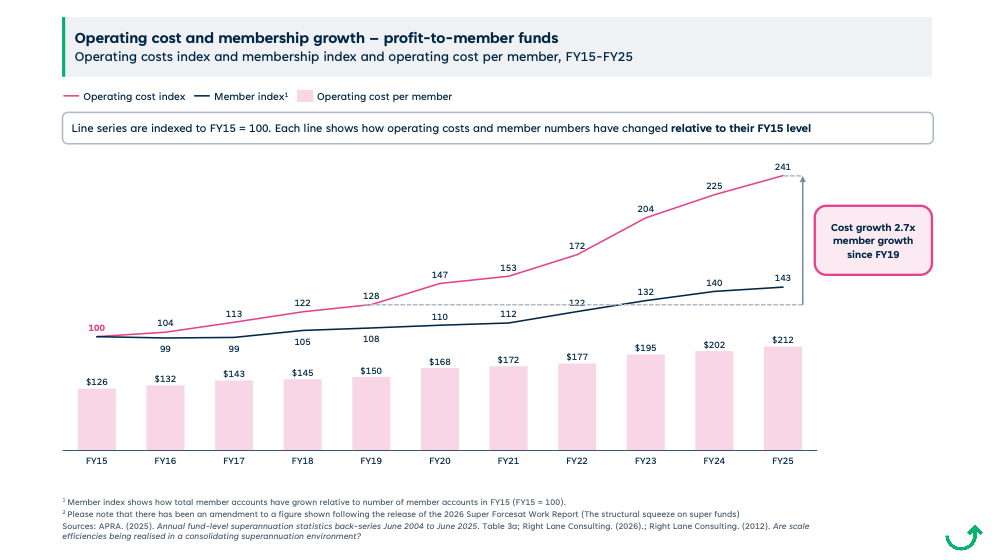
As system-level complexity and other drivers such as regulatory requirements in the industry grow, we anticipate that funds will increasingly need to find ways to manage rising operational costs to ensure that the impact of costs to member accounts is justified. This reflects a broader shift in the system: historically, growth was about reaching minimum efficient scale and becoming cost competitive. Today, many funds have achieved that scale but are now facing rising complexity and higher expectations from members, policymakers and regulators. The next wave of pressure will come from areas that are inherently harder to absorb through scale: service expectations, regulation, technology, governance and administration.
An effective cost oversight and management system is therefore going to be a critical aspect of good governance in future.
What can be done about it? Use a ‘cost-by-design’ lens
There is an important structural distinction in how different cost categories behave. Investment costs tend to scale with FUM, making unit cost the more relevant measure. Operating costs, by contrast, are more closely linked to member numbers and, as we argue above, increasingly to system complexity.
Scale alone is no longer sufficient to manage the total cost curve.
If funds want to continue improving member outcomes without allowing complexity to compound, a different approach is required. Rather than managing costs after they emerge, funds will increasingly need to focus on deliberate choices about where to simplify, standardise and invest by developing a framework that is a key part of fund oversight and management. This is where a ‘cost-by-design’ mindset becomes critical.
We explore these themes further in the latest Super Forces at Work Report, including what a ‘cost-by-design’ approach looks like in practice and the implications for operating model, governance and capability. We believe that all funds should be taking a more strategic approach to cost management.
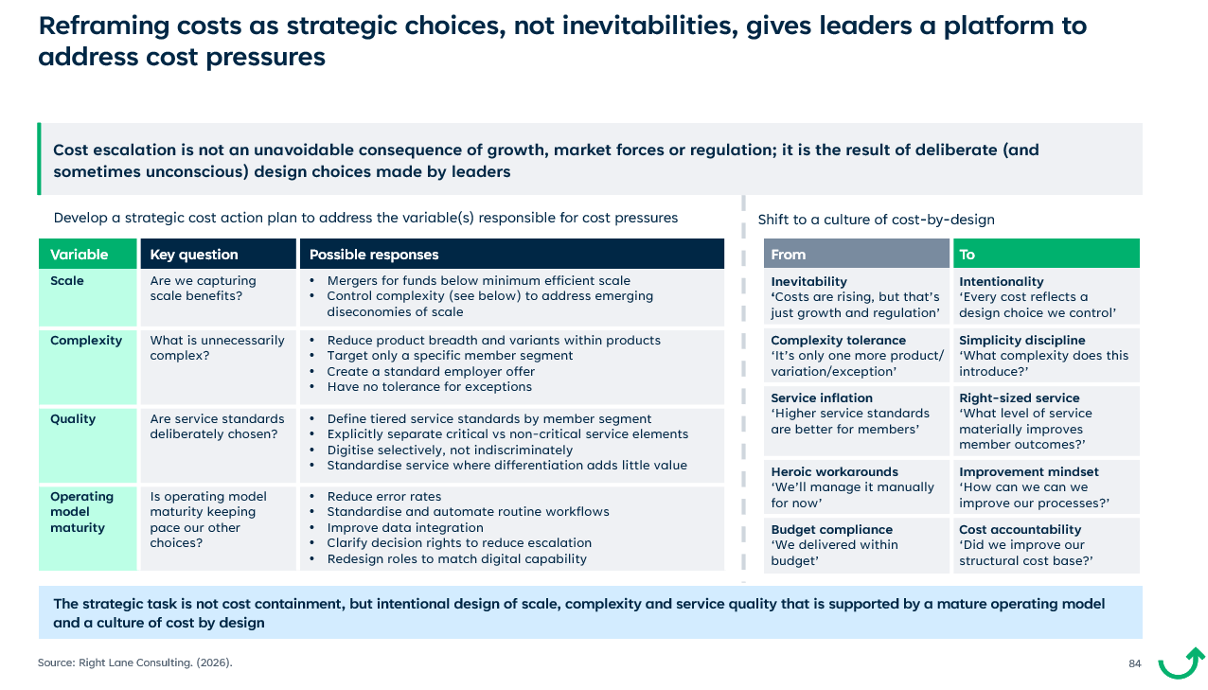
Reframing cost management as a strategic choice
Viewing costs through a ‘scale-complexity-quality’ lens helps understand the drivers of cost pressures. Using our ‘scale-complexity-quality’ framework is a way of explaining how a fund’s cost base is structurally driven by its scale, the complexity of its offering and its service quality, within the context of a given operating model maturity levelThis reframes the cost challenge from a focus on driving down costs to a strategic decision over the level of complexity and service quality desired and on optimising the right operating model to deliver.
We make a call to action for all boards and executives to develop a strategic cost action plan to reframe the cost management focus using a ‘cost-by-design’ lens.
If you would like to discuss how these issues are playing out in your organisation, we would welcome the opportunity to explore this with you. Please get in touch.
Strengthening our ability to solve superannuation’s toughest challenges
At Right Lane, we tend to keep the focus on the work rather than the individuals behind it. This appointment, however, is significant for our clients and friends across the sector.
We’re delighted to welcome Dr Ellie Boston‑Clark to our superannuation leadership team. Ellie joins us from Willis Towers Watson, where she was Co‑Head of Governance, Investments (Australia). She brings nearly 20 years’ experience across the superannuation and global pensions landscape, is a qualified actuary with a PhD in mathematics, and has worked closely with leading asset owners globally.
Over the past 4 years, Ellie has advised leading super funds and global asset owners on investment governance and organisational effectiveness at board and investment committee level. Prior to this, she spent 14 years as a strategic retirement consultant, helping funds develop and implement retirement and risk management strategies.
Ellie’s experience translates directly into today’s context of Australian superannuation, where governance, retirement adequacy and risk management are under increasing scrutiny. She works closely with boards and executives to bring clarity to complex issues and align strategy with long‑term member outcomes.
She joins an already :
- Dr Marc Levy, Founder and Chair of Right Lane, brings more than 25 years’ experience in the sector. He has led over 200 consulting projects in super and is the firm’s leading knowledge contributor, including the annual Super Forces at Work Report.
- Zoe Pappas, Partner and Executive Director, has 15 years’ experience advising on strategy, growth and operating model transformation, supporting many funds on complex, system‑level challenges.
- Gemma Pinnell, Partner, has 13 years’ experience in super, including time as a trustee director of AustralianSuper and at ISA. She specialises in stakeholder engagement and policy, and leads complex, insight‑driven engagements across the sector.
- Debbie Williams, Senior Expert, has 15 years’ experience in governance, strategy, growth and organisation design, and is currently working on Right Lane’s cost‑by‑design service in response to rising cost pressures.
Together, this team combines deep technical expertise with extensive sector experience, and reflects our continued focus on supporting clients on their most complex and important challenges.
We hope you find these insights useful. Please send me any feedback and if you would like we can publish it with the next issue, attributed or not, as you wish.
With the release of our 2026 Super Forces at Work Report, we are in presentation mode. If you would like us to present insights to your board, executive team or SLT, please get in touch.
About Inside Super
The focus of Inside Super is on superannuation industry strategy, structure, scale economies, competition and growth – topics central to the work Right Lane has been doing for more than 25 years. We won’t be building the content from scratch. We’ve been writing about forces at work in the industry for 13 years in our annual, subscriber-only Forces at Work in Super Report.
In each issue, I choose a chart or two from the back issues of the Report (there’s ~1,100 pages to draw from!), and connect them up with something that’s happening right now in, for example, the competitive arena or the policy discourse. I also make some observations and suggest some questions you and your team should contemplate.
With the 2025 Forces at Work Report having been recently released, we are in presentation mode. If you are wondering whether your organisation is a subscriber, and if so whether you can get a copy, or if you would like us to present some of the Report findings to your team, please let me know.
I plan on writing editions of Inside Super semi frequently. If you do not wish to receive these updates, please let me know via return email and I will take you off the list.