Inside Super #8
From capability to outcomes
In this issue of Inside Super, we explore a theme emerging from conversations with leaders across the superannuation sector: capability alone does not guarantee outcomes. From the governance and operating conditions that support strong investment decisions to the confidence members need to navigate retirement, the focus is shifting to how expertise and intent are translated into meaningful results.
One of the highlights of my time at Right Lane so far has been listening to leaders from across the superannuation sector. In recent months, I have spoken with board directors, investment committee chairs, CIOs and senior executives from funds with different histories, operating models and priorities, alongside senior colleagues in Right Lane’s superannuation practice, Zoe Pappas, Gemma Pinnell and Marc Levy. We asked a consistent set of questions to understand what sits beyond investment capability in driving strong outcomes today, and where funds will need to change over the next few years to deliver better outcomes for members.
What struck me was not where their views differed but where they converged. Across strategy, investment, governance and retirement, the same challenge kept surfacing: turning expertise, resources and intent into real-world results.
So what did we hear? The common thread was that capability alone is rarely enough. Increasingly, outcomes are shaped by the quality of the decisions, governance and execution that surround it.
Strong investment outcomes rely on more than investment capability
Investment skill remains fundamental. But, alongside that, many of the factors that senior leaders point to as critical to success sit around the investment process rather than within it.
Our discussions with the CIOs and investment executives highlighted the areas investment teams are increasingly spending energy and focus on sharpening are the softer elements. Themes such as:
- Trust between boards, investment committees and management
- Clear decision rights
- Constructive challenge
- Well-defined accountability
- Effective risk ownership
- Operating models that allow investment teams to act efficiently
These are not new concepts. However, their importance appears to be increasing as investment organisations become larger, more specialised and more complex.
The ability to execute investment capability increasingly depends on the organisational environment around it. Attention is shifting to the organisational conditions that support investment success, and those that can hinder it. As funds grow and become more complex, some of the most important investment questions become organisational questions.
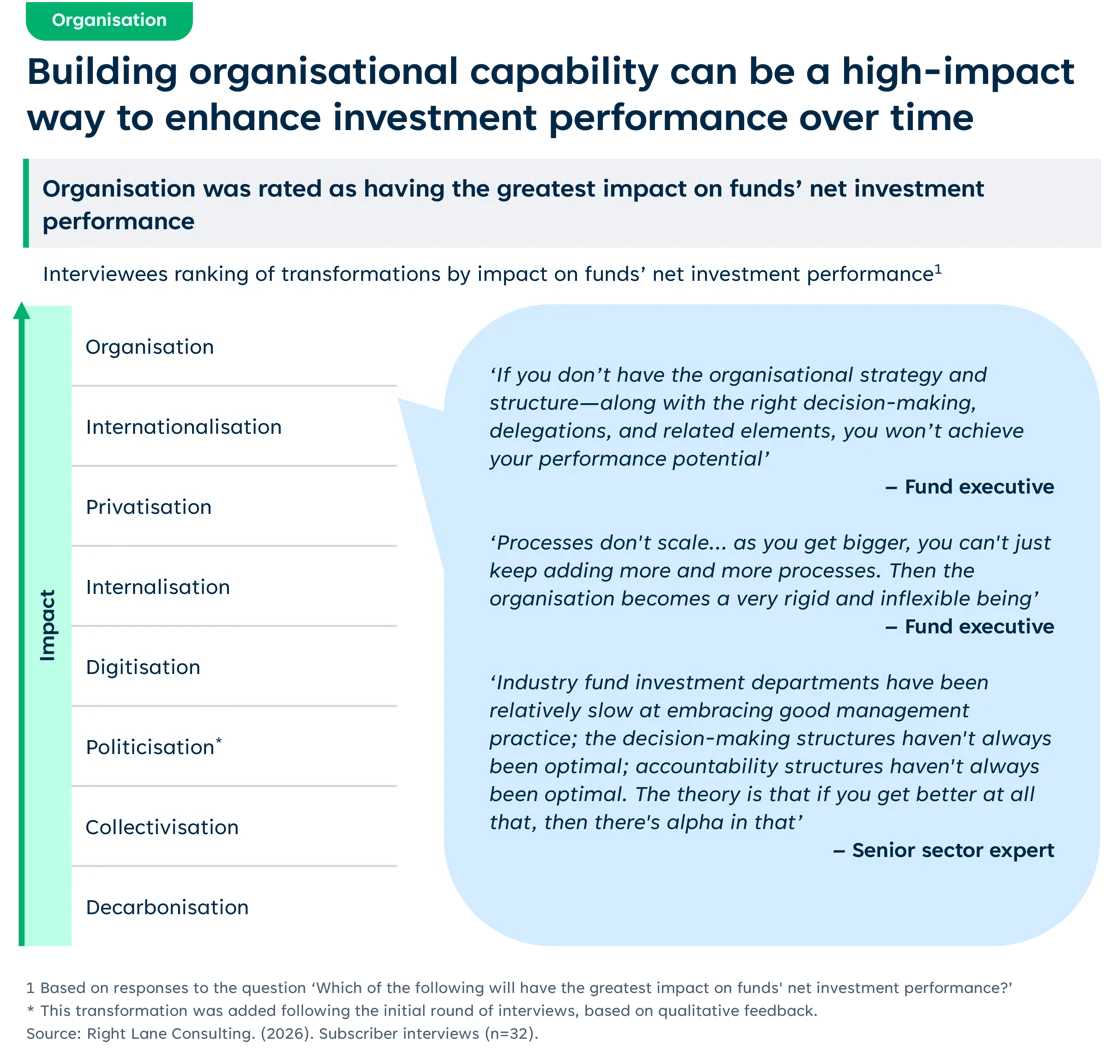
Responsibilities begin to overlap. Teams become more specialised and sometimes more disconnected. Governance arrangements evolve organically over time. Decision-making processes that once worked well become less effective as organisations change around them. These features are the natural consequences of organisational maturity.
As a result, many super funds are increasingly having to apply the same level of discipline to how their investment functions operate as they do to how they invest.
The practical implication is that boards and executives may need to spend less time asking whether governance structures exist and more time asking whether they still work as intended.
QUESTIONS FOR BOARDS AND EXECUTIVES
As investment operating models continue to evolve, these questions are becoming increasingly important. Ultimately, the goal is not only about better governance. It is about creating the clarity, speed, trust and accountability for investment teams to make better decisions and execute them effectively.
Retirement may not be the challenge we think it is
Having spent much of my career working with funds on retirement strategy, I hoped retirement would emerge as a major theme in these discussions. It did.
What surprised me was the nature of the discussion.
The conversations were rarely about a particular retirement product or solution but instead kept returning to the same fundamental issue: how do funds really help members make decisions with confidence?
For me, this makes sense. Members rarely wake up wondering whether their fund has the optimal retirement architecture. Their concerns are more immediate and personal.
THE QUESTIONS MEMBERS ARE ASKING
These are not just product questions. They are behavioural questions about how people navigate critical decisions under uncertainty. Time and again, the conversations returned to helping members make decisions with greater confidence. Creating clarity and confidence for members may ultimately be just as important as designing the right retirement solution. Viewed through this lens, retirement starts to look less like a product challenge and more like a behavioural challenge.
A fundamental challenge for the industry goes beyond creating good retirement solutions. It is helping large numbers of members understand, trust and act on them.
Superannuation has been built on scale, whereas member confidence is often built one conversation at a time. The industry therefore faces an interesting tension. How do funds deliver more personalised guidance, support and reassurance without creating a service model that becomes prohibitively expensive?
For many funds, the opportunity may increasingly lie in understanding how confidence is built, reinforced and sustained across the whole member life journey.
Investment and retirement share a common challenge: translating capability into outcomes
One concerns institutional decision-making. The other concerns individual decision-making. Yet both ultimately depend on the quality of the decisions that are made.
For investment teams, that means creating the conditions for good decisions. For members, it means creating the confidence to make them. After speaking with leaders across the sector, I was struck by how often the conversation returned to this idea. The challenge is increasingly not capability itself, but ensuring capability consistently translates into outcomes.
My thanks to everyone who took the time to share their perspectives during these discussions.
I’d welcome your thoughts
I hope you find these insights useful. Please send me any feedback.
If you’d like to discuss what these insights could mean for your Fund, book a time to meet with me. I’d love to connect.
About Inside Super
The focus of Inside Super is on superannuation industry strategy, structure, scale economies, competition and growth. These are topics central to the work Right Lane Consulting has been doing for more than 25 years. We aren’t building this content from scratch: we’ve been writing about forces at work in the industry for 14 years in our annual, subscriber-only Forces at Work in Super Report.